Showing posts sorted by relevance for query proclaimer. Sort by date Show all posts

Thursday, February 10, 2011

Faith Comes By Hearing

The weekend in Can-eo and Chapyosen was fantastic! Soon after arriving in Can-eo, we walked to the house of one of the church elders, Delfin, who has been leading the outreach to Chapyosen. There I presented him with a Proclaimer and taught him and Pastor Rudy how to use it. I wanted the device to be a tool presented by the elders of Can-eo to be used by the church in Chapyosen – not a gadget from the Americano.
Delfin and Pastor Rudy getting familiar with the Proclaimer controls

Then we began the long hike to Chapyosen. Fortunately, the weather was pleasant and the path was not muddy. It took us about an hour.
A flat portion of the trail to Chapyosen

Upon crossing the river on the footbridge, we climbed a steep hill to the edge of the village. In the space used to press the sugar cane, we stopped to pray for our time in the village. Pastor Rudy suggested that John 3 would be a good passage for us to use to introduce the Proclaimer to the people.

We gathered under someone’s home, most of us lining the perimeter between the stilts that held the house above our heads. The weaving projects had been rolled up and pushed aside, but several wooden frames polished with age that the ladies use when they weave using backstrap looms were scattered about the dusty concrete floor.
The meeting place

In addition to the 17 adult residents, many children wandered in and out during the gathering. Several of the mothers had babies in their arms or tied on their backs with sarangs. One young girl had a length of the beautiful red, black, and white fabric that is woven in the village tied about her, supporting a younger sibling.

After a few introductions were made, a sip of sugar cane wine was offered to Pastor Rudy. He explained to me that refusal would have been insulting to the people and that he would not have been welcome to return. It smelled very strong and I was just as happy to not have been offered a taste.

When the Proclaimer was turned on, everyone was thoroughly attentive. Even the children who had stayed with the adults were still while the voices spoke the story of Nicodemus’s encounter with Jesus in the Ilocano language. In the common story-telling method here, the passage was played a second time to ensure everyone heard it.
Delfin holding the Proclaimer as it played through the story of John 3

Listening to the story...

After the story was told, there was not much talk about the Proclaimer. Instead, there was an intense discussion, mostly involving the old women, about Jehovah and Lumawig (the name of the local spirit-god). Because I don’t know the language, I could not understand all that was said. But after Pastor Rudy and Delfin answered questions, the people seemed to be much more comfortable with the discussion.

Apparently they are interested in continuing to learn about God – the true God. They discussed who would be the one to care for the Proclaimer between meetings. They were concerned about the children damaging it and being able to operate it. They decided an old man with no children in his house would be the one to keep it at his place. A lady with several children is to be the operator, although Delfin demonstrated how to use it in front of all present. Chapyosen is a remote village with no electricity so gadgets we consider simple can be somewhat intimidating to these people. I was glad that even with the discussion about Lumawig the people desired to use the Proclaimer so they could continue to hear the Gospel. It was also an encouraging sign that they welcomed us back.
Delfin with the man who would care for the Proclaimer and the lady, Espirita, who was designated by the group to operate it.

Before we left, we took some group photos. When I went to sit with the group, I was going to stand at the back but was told to sit near the front in the middle. As I was sitting down, an elderly lady, Hananio, put both arms around me. I wish I could have understood her words, but her smile and unusual display of affection said a lot to me. Even as I write this, I cannot help but smile at the memory of it.
Thomas with the new church in Chapyosen

Back in Can-eo Sunday morning, Lisa and the girls arrived with an outreach team from YWAM Baguio’s Family Ministry School. The team was scheduled to present about marriage and family life during the service and a seminar after lunch. Even after only a day away, I was so glad to see my 5 ladies. The girls were excited to be in Can-eo again. Before we left in the evening, they had found some of their friends and had taken team members to some of their favorite places.
At the end of the church service at Can-eo Station Church, I presented another Proclaimer to Pastor Rudy. He in turn, presented the Proclaimer to Johnny. Johnny is an elder of the church who lives in the sitio of Fangkeg, one of the 4 sitios that make up Can-eo. Fangkeg is the most distant sitio from the church and is a difficult walk in the dark or in the rain. We hope to encourage Bible studies with those who cannot or may not yet be willing to make the hike to the church to learn about following Jesus.
Presenting a Proclaimer to Pastor Rudy at Can-eo Station Church

Pastor Rudy explaining the Proclaimer to the congregation

Pastor Rudy instructing Johnny how to use the Proclaimer

Fangkeg

Grace,
Tom

Tuesday, January 31, 2012

3 Gifts for Anabel

To explore the area, click here
This weekend we had the opportunity to visit the village of Anabel. This small village has a unique setting with a memorable bridge.

When we arrived at the village, we looked for Kindel who had arranged for our visit. Kindel is a former SSM student who then completed the Tribal DTS and just completed staffing the Family DTS in Baguio. We found her sorting through coffee beans.
Adriana and Kindel sorting through coffee beans
Coffee beans growing on the tree
When she was done with the coffee, Kindel took us for a walk around the village.
There is always a hill to climb
We did not play any basketball, but I thought the goal was worth a photo.
Basketball anyone?
As with every village in the region, Anabel is an agricultural community. You can not walk too far without passing pigs and chickens. In the photo below, the pig that had been standing with the rooster has matching coloring but was too shy for the photo.
Below is Agnes who has always been so kind to open her home to us when we stay in Anabel.
Agnes giving a lesson on weaving banana leaves into a packet to hold sticky rice
Going to the villages is always a great time to practice our Ilocano with new friends and old.


Paulina was threshing the rice she recently finished pounding in the mortar on which the basket is sitting
It was decided that we would install a solar bottle-light in Paulina's house. The room in which we were to install the light was completely dark if the window and door were closed, and there was no electrical lighting in the room.

Saturday evening, Pastor Marlon and others gathered to see how the solar bottle-light was prepared and to see the rocket stove I had brought.
Preparing the solar bottle-light which would be installed in Paulina's home the next day
I could see there were many people crowded into Agnes's house, but because I was busy, I did not notice how many people were also outside of the house.

I described the construction and use of the rocket stove, but most of my attention was given to preparing the bottle-light for installation. As the pastor and I worked on that, the ladies investigated the rocket stove. It was not long before they had it outside, boiling water in a tea pot.
Adriana, Kindel, and Jacqueline looking over the rocket stove
In the morning, Arthur came over from next door and asked if he could use the rocket stove.

I had expected the bottle-light to be of most interest to people, but it was obvious that people could see immediate benefits to the rocket stove. Behind Rudy, the man in the black shirt, you can see the dirty kitchen at Arthur's house. Most homes in Anabel use dirty kitchens (referred to as dirty because of the soot build-up from the open cooking fire) because LP for gas stoves is expensive and heavy to carry from the jeepney, across the bridge, through the rice fields, and up the hill to the village. The rocket stove is helpful because it creates less smoke and uses much less wood than an open fire.
When I went next door to talk with Arthur, his neighbor brought over a large can and asked if I could make her a rocket stove using the large can in the picture below. Rudy and I cut and fitted as people brought the cans we asked for.
I had not made one this size before, but it seemed to work well. Instead of using ash to insulate the chimney, we tried a 50/50 mix of clay and rice hulls. I hope to hear which works better so I can teach the best technique as I introduce the rocket stove to other communities.

The title of this post refers to 3 gifts for Anabel. The first two, the solar bottle-light and the rocket stove, will hopefully make things a little easier for their daily living. The last gift has a much more important and lasting goal. The Proclaimer the YWAM Salem CDTS team brought did not work, so when they returned to the US, they got a replacement and sent it to us. After presenting a teaching about God's story of redemption through an overview of the Bible, we used the Proclaimer to listen to the climax of the story, the crucifixion and resurrection of Jesus. We then had the honor of presenting the Proclaimer to the people of Anabel. We pray the gift of God's word will transform lives for eternity.
Listening to the crucifixion and resurrection in Ilocano using the Proclaimer
Presenting the Proclaimer to Pastor Marlon
After I taught Pastor Marlon to use the Proclaimer's controls, he brought together some of the leaders within the congregation and taught them.
Pastor Marlon and church leaders
After church, we met Pastor Marlon at Paulina's house for the solar bottle-light installation.
Paulina's house
While we installed the bottle-light, Alayna read to the children from the translation of the Read Aloud Bible Stories we have been working on.
Alayna reading a translation of a children's Bible story book
The installation went well with the exception of the nails we used to anchor it in place, Pastor and I both bent a couple. The wood was hard as rock, having been baked beneath the galvanized roofing for so many years. Of course it was hot on the roof, but my biggest concern was making sure I was only putting my weight on the supported portion of the roof. A wrong step would have put a much larger hole that intended in Paulina's roof.

Paulina and Thomas with her new light
"Yesterday before that one was installed it was very dark." ~Paulina

Before we left to catch the jeepney, we were invited to pray with Manuela for her daughter in Baguio recovering from surgery.
Lisa, Manuela, and Adriana
We thought we would leave then, but were told there was a while before the jeepney would arrive and there was another request for a rocket stove. So Pastor Marlon and I made another, working until someone said it was time for us hike back to catch the jeepney.

However, our timing was a little off and the jeepney had already left. Plan B - hike up to the road and catch a ride with a passing jeepney, bus, or vegetable truck. From Anabel to the road is about 1.5 kilometers in length and about 400 feet up. We were all glad to have some sugar cane to snack on as we waited especially since our store of water for the weekend was basically depleted.
Alayna and Annalise enjoying sugar cane
After an hour, we began to doubt that Plan B was going to work out. A resident from Anabel who was also waiting for a ride suggested our best plan, Plan C, was to hike to the next village, Tocucan, another 5.5 kilometers. Fortunately, Jerry was gracious and offered to carry one of our large duffel bags with our bedding.
Jerry leading the pack on the hike to Tocucan
It was well after dark when we arrived in Tocucan. In the 2 hours it took us to hike to Tocucan, no large vehicles had passed us, only a few motorcycles. One of these motorcycles was driven by our friend Steve on his return from pastoring in the village of Saclit. He offered to take Annalise to Bontoc and wait for us there. In Tocucan, Jerry made arrangements for a trike to take the rest of us to Bontoc. It would take two trips. Not long after Lisa, Alexie, and Alayna left, another friend showed up. Steve and Annalise had arrived at Pastor Rudy's house in Bontoc and he took his truck to fetch us. Pastor Rudy had stopped the trike the girls were in and they were in the truck when he came to get Adriana and me.

Finally, we made it home. It was a good weekend which will be memorable for many reasons.

Grace,
Thomas

Friday, March 25, 2011

Stepping Up to Saclit


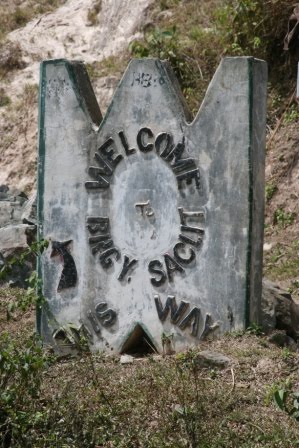
A friend of mine is a pastor in two Barangays of Bontoc, Mountain Province. The first, and his home, is in Bontoc where he ministers to students who board at his church as well as others from the community. The second place is in the village of Saclit, about 2 ½ hours away. Until he began making the trip to Saclit last year, no evangelical Christian pastor had been teaching the people there for a number of years.
Village on the Mountain

The village of Saclit has a road going most of the way to it, but is high on a mountain and isolated from other places. Bontoc has the nearest hospital and public market. The nearest police station is in Sadanga, about an hour away. Fortunately, they do have electricity and springs higher in the mountain provide a source of running water.
Rice Terraces from Above

The people of Saclit are farmers. They rely on the rice grown in terraces carved into the side of the mountain. Other main crops include peanuts and sugar cane. Chickens run free under and around the houses. This was my first visit to Saclit and I found it interesting how many pigs were free to roam. Most villages I have visited keep their pigs in pens, but here a pig in a pen was the exception.
Pig at the Door

As with other villages in the province, the Igorot people still cling to animistic practices. There is a high place with a large “grandfather tree” under which sacrifices of pigs, chickens, or carabao (water buffalo) are made for planting, harvest, and in observance of other rituals. But there is a faithful remnant of God’s children even here!

On the weekend of March 19 and 20, 2011, I was honored to accompany my friend, Pastor Steve, to the village of Saclit. As we approached the road going up to the village from the main road, the jeepney was blocked by road construction. Concrete had just been poured on the main road and the jeepney could not make the turn without destroying the newly poured road. As a result, we had to hike the rest of the way. It took us more than 1 ½ hours to hike from the main road to the village – even though we used the steep footpath which bypassed one of the long cutbacks of the serpentine dirt road up the side of the mountain.
Jeepney at (No)Turn-off to Road to Saclit

Hike Up to Saclit
- If you look
closely, you can see the road on the mountainside behind me.

Thomas, Pastor Steve, Alex, and Miguela

Saturday evening, we met with people in the home of our hosts, Alex and Miguela. Because it is planting time in the village, it was late before people began to arrive. Our Bible study did not even begin until after 9 pm. The people of Saclit speak little English, so Pastor Steve translated as we talked through the story of redemption the Bible reveals. Then we listened to Matthew 27 and 28 using the Proclaimer. Though it was late and those gathered had worked hard all day, even the children listened attentively as the story of the crucifixion and resurrection were dramatized in Ilocano. At the end of each chapter, Pastor Steve and I asked questions to ensure people understood and internalized the story they just heard. Most were amazed that the people present at His crucifixion still did not believe.
Carol Listening to the Story

Saturday Night Bible Study

Several commented that hearing the story on the Proclaimer greatly helped their understanding as opposed to someone reading to them. My experience is that people in this area have limited exposure to stories being read aloud with vivid expression. The illiteracy, poverty, and differences among the various dialects spoken here often make it so that when people are reading aloud it is not smooth and expressive but halting and flat.
Thomas Praying for Lazaro

Sunday morning, we packed up and headed to the church building located in the lower part of the village. On our way, we stopped to visit baby Lazaro. He is 6 months old and has respiratory issues that make every breath a conscious effort. My heart broke as I held his frail little body in my arms. Even his cry was weak and labored. We prayed for him before continuing on to the church building.
Church Building in Saclit

There is not a set time for the beginning of service for the church. About 9 am, Pastor Steve began singing hymns translated into Ilocano and people gathered. In all, about 25 men, women, and children attended. As this is a different group of people than those that had gathered the night before, Pastor Steve had suggested that we repeat the teaching we had already given.
Listening to the Proclaimer

Pastor Steve Explaining

Except for a couple of energetic boys about 2 years old, once again everyone listened intently as the Proclaimer played the stories of the crucifixion and resurrection. After talking about the story I asked if there was anyone who had not yet given their life to Christ and made Him their leader. It was nearly unanimous that people wanted to do so. Not knowing if I had been understood properly or if the hospitality of the people made them eager to please their guest, I asked Pastor Steve to explain that they did not need to do this if they had done so in the past. We also made it clear that if they made this commitment, then they could never again serve Lumawig or the other spirits, but Christ alone. None changed their mind. Almost the entire congregation gave their hearts to Christ after having the story of redemption taught to them and listening to the crucifixion and resurrection using the Proclaimer! Pastor Steve and I are overwhelmed at what the Holy Spirit did that morning!
The Church at Saclit

After service, I was blessed as several people provided me with a bag of peanuts as a token of appreciation for my coming to their place. Although I never mentioned it, they knew that I had hiked up from the road and were thankful for my effort to reach them. I was repeatedly invited back and was asked to bring my family the next time.

That made me…
Happy!

Grace,
Tom